


Ask any CPA firm about September 15, and you’ll probably get the same response: “It’s a big day.” It is (almost equivalent to) the “Friday the 13th” of the tax world.
For many CPA firms, the September 15 tax deadline is like a second busy season. S-corp and partnership extension returns land at once. Form 1120-S deadline and Form 1065 deadline filings compete for the same reviewers. Clients send documents late. Review queues grow. Partners end up back in late-night review sessions they thought they left behind in April.
The September 15 tax deadline is near. And, CPA firms must focus on capacity planning for this tax season. Let’s cut to the chase and discuss:
- Hidden challenges during the busy tax season
- Realistic CPA firm capacity planning for tax season
- Where outsourced tax preparation for accounting firms can help
Key takeaways:
- The September 15 tax deadline exposes existing capacity gaps. It does not create new ones.
- Reviewer bandwidth, not preparer headcount, is usually the real bottleneck during tax season.
- Capacity constraints carry operational, financial, and people costs that extend past the deadline itself.
- Firms that plan capacity ahead of time protect margins and staff retention better than firms that react to the crunch.
Why the September 15 tax deadline feels like a second busy season
Unlike the March or April filing rush, September is often dominated by complexity.
Returns filed under extension frequently involve pass-through entities, multi-state filings, additional review layers, or clients who needed extra time to finalize financial information.
As a result, the work leading up to the Form 1120-S deadline and Form 1065 deadline often requires more collaboration, more reviewer attention, and more judgment than routine compliance work.
Suggested read: IRS Forms 1120S, 1065, and 1120 in 2026 key deadlines
At the same time, business doesn’t pause operations. Advisory engagements continue. Bookkeeping deadlines remain. Client emails keep arriving. Internal meetings still happen. Partners are expected to lead the firm while simultaneously reviewing returns late into the evening. That’s when firms experience availability and staff capacity issues.
💡 Is Outsourcing Right for Your Firm?
Take our quick self-evaluation to assess whether outsourcing or offshoring fits your firm’s goals.
Instantly discover how it can impact cost savings, capacity, and growth potential.
No commitment. Just tailored insights in less than 2 minutes.
How capacity gaps quickly become business consequences
When discussions around staffing focus only on overtime hours, they miss the broader business impact. Limited capacity creates ripple effects across the entire firm.
Review queues become longer, forcing senior professionals to spend more time clearing backlogs instead of advising clients or developing new business. Junior staff wait for feedback, slowing overall turnaround times.
Administrative tasks interrupt reviewers throughout the day, making focused work increasingly difficult.
As deadlines approach, teams often shift into reactive mode, prioritizing speed over process consistency. While most firms still deliver high-quality work, maintaining that standard requires significant personal effort from partners and managers.
The cost isn’t measured only in extra hours. Here are some hidden challenges that surface during the busy tax season:
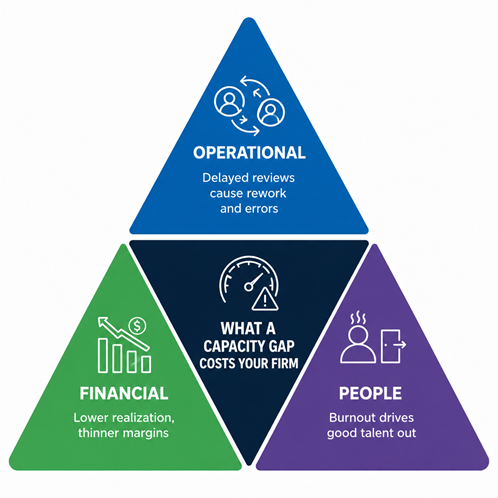
- Reviewer capacity erodes through the season.
- Complexity matters more than return volume.
- Mixed workloads create hidden inefficiencies.
- Staff attrition starts before resignations.
- Compliance pressure crowds out advisory work.
Burnout from tax season staffing shortages drives good staff out the door, often right after the deadline passes, not during it. Losing a senior preparer in late September is a direct result of how the firm handled July and August.
Suggested read: Survival tips to avoiding burnout during this tax season & beyond
For many firms, the recurring tax season staffing shortage directly affects on the operational front.
Realistic CPA firm capacity playbook & planning for tax season
While every firm has its own workflows, the firms that consistently navigate extension season well tend to share a common approach. They plan for capacity as deliberately as they plan for deadlines. Here are five practical ways to build capacity during the September 15 tax deadline:
- Forecast workload, not just deadlines
Many firms build timelines around statutory deadlines. The stronger approach is to map workload against available capacity.
Ask questions like:
- How many complex returns are expected over the next four weeks?
- Where will reviewer bandwidth become constrained?
- Which engagements require partner-level review?
- What happens if a key team member becomes unavailable?
Capacity planning shifts the conversation from “Can we finish?” to “Do we have the resources to finish sustainably?” This is the foundation of effective CPA firm capacity planning during tax season.
- Prioritize returns by complexity
Not every return carries the same level of effort.
Grouping engagements based on complexity, review requirements, and client priorities allows firms to allocate experienced professionals where they create the greatest value.
Simple production work should move efficiently through standardized workflows, while reviewers focus on returns that require technical expertise and judgment.
The result is a more predictable workflow with fewer last-minute surprises.
- Protect reviewer time
In many firms, reviewers, not preparers, become the true bottleneck.
A senior manager who spends the day answering administrative questions, searching for missing documentation, or switching between multiple projects has less uninterrupted time to complete reviews.
Protecting reviewer capacity may involve:
- Standardized workpapers
- Clear documentation requirements
- Better internal handoffs
- Reduced administrative interruptions
Small operational improvements often have an outsized impact during September.
Standardize Repeatable Work
Every unnecessary decision consumes valuable time. Checklists, templates, documented processes, and consistent file organization help reduce friction across teams. Standardization doesn’t replace professional judgment. It simply allows professionals to spend more time applying that judgment where it matters most.
Build flexible capacity before the crunch
Not every capacity gap needs another full-time hire, especially one you won’t have trained in time anyway. The accounting profession continues to face ongoing talent shortages. It is becoming increasingly difficult to recruit experienced professionals before peak periods arrive.
Forward-looking firms are responding by building more flexible delivery models. That may include cross-training internal teams, leveraging automation, or using overflow staffing for accounting firms during periods of peak demand. Increasingly, firms are also exploring outsourced tax preparation for accounting firms as part of a broader capacity strategy. Not to replace their internal teams, but to extend them.
When repeatable preparation work can be handled by trusted external professionals, internal staff gain more time to focus on reviews, client communication, and higher-value advisory work.
Rather than viewing outsourcing as a temporary fix, many firms now see it as one component of a more resilient operating model.

Capacity checklist: are you set for the September 15 push?
How to use this: Run through this by August 1, not the week before the deadline. Pull actual numbers where you can. If a box stays unchecked, that’s your priority list for the next four weeks, not a vague area for “improvement.”
Workload visibility
- You’ve counted open extensions by entity type (1120-S, 1065, 1040) and by complexity tier, not just a total return count
- You know how many of those returns are multi-state, multi-owner, or involve K-1s from other pass-throughs, since these take longest to review
- You’ve flagged returns still missing client documents as of August 1, and you have a follow-up cadence for each one, not a general reminder email
Reviewer capacity
- You’ve mapped how many returns each reviewer can realistically clear per week during this stretch, based on last year’s actual numbers, not a target
- You’ve compared that number against your open return count and know if you’re short, and by how many returns
- You’ve blocked reviewer calendars to protect review time from client calls and internal meetings during the final two weeks
Contingency
- You have a named backup reviewer for each primary reviewer, in case someone is out sick or leaves
- You know your firm’s break point: the return count at which you’d need to bring in outside help, and you’ve set that number now, not when you hit it
Workflow
- Every preparer is using the same workpaper template and checklist for a given return type, so reviewers aren’t relearning a new format each time
- Preparers are batching similar returns together instead of jumping between entity types, since context switching is what slows reviewers down most
Capacity flexibility
- You’ve decided in advance what work you’d hand off first if you needed extra hands: simpler returns, bookkeeping cleanup, or data entry, so you’re not deciding this under pressure
- If you’re considering outsourced or overflow support, you’ve already identified a partner and confirmed turnaround time and security credentials, instead of starting that search once you’re already behind
More than one ‘no’ here means it’s worth revisiting the plan before, not during, the next deadline.
The point of this list isn’t to confirm you’re busy. It’s to tell you, in numbers, exactly where you’ll break if volume runs 10-15% ahead of forecast, and what you’d do about it before that happens.
Where outsourced tax preparation for accounting firms can help
Outsourcing doesn’t fix a firm that hasn’t planned its capacity. It’s a lever, not a substitute for the planning above. Used well, it targets specific pressure points rather than acting as a blanket fix.
- Offload lower-complexity returns first to free senior reviewers for high-value work.
- Increase reviewer capacity, not just preparer capacity by reducing review bottlenecks.
- Prevent post-deadline backlogs by outsourcing bookkeeping, data entry, and routine returns.
- Scale capacity up or down as needed without committing to permanent hires.
- Engage outsourcing partners before the rush to avoid onboarding delays during peak season.
In a nutshell
The September 15 tax deadline isn’t just a date. It’s a test of how well your firm plans for demand. The firms that handle S-corp and partnership extension season well aren’t necessarily the biggest ones. They’re the ones that forecast workload, protect reviewer time, and put flexible capacity in place before they need it.
If you’re a managing partner or ops director looking at ways to build capacity without adding permanent headcount, it’s worth a look at how outsourced tax preparation for accounting firms fits into that plan.
Explore Datamatics’ tax preparation services to see how scalable support can help your firm handle tax season staffing shortages without sacrificing quality or turnaround.
What returns are due on September 15?
Extended tax returns for partnerships and S corporations are due by September 15.
How should CPA firms plan capacity for the September 15 deadline?
To plan capacity for the September 15 deadline without exhausting your in-house team, start by analyzing beyond your staff’s availability. Check for time lost in admin work, client communication, and rework. Track these diligently to adjust workload. Next, stay on track by prioritizing returns and planning resources realistically.