


How to measure the real ROI of an outsourced accounting service

>
>
How to measure the real ROI of an outsourced accounting service

Ask ten managing partners how they judge an outsourced accounting service, and most will point to one figure: the hourly rate. It feels precise. It fits neatly on a spreadsheet. And it tells you almost nothing about what the engagement actually returned. The honest problem with the outsourced accounting service ROI conversation is that firms measure the input and skip the outcome. That gap is where good decisions quietly go wrong, and where real return hides in plain sight.

The number partners obsess over is the wrong one

Rate-per-hour comparisons win partner meetings for a simple reason: they’re easy to defend. You can say “$28 an hour versus a $75,000 staff seat” and everyone nods. The math looks airtight.

Here’s the thing, though. That number ignores capacity, margin, and retention, the three levers that actually decide whether an engagement pays off. A cheap rate on work that arrives late, needs rework, or frees no partner time isn’t cheap at all.

The rate persists because it’s concrete, and concrete beats correct in most conversations. Nobody gets challenged for citing a price. You do get challenged for claiming “reclaimed advisory capacity” without a number behind it.

To be fair, rate isn’t useless. It’s a starting input for cost-benefit analysis of outsourced accounting, not the conclusion. The trap is treating one line item as if it were the whole return. Return on investment of outsourced accounting services lives in what the rate makes possible, not the rate itself.

Why the talent shortage changed the ROI math

The context around this decision has shifted hard, and the old cost-cutting logic no longer fits. The AICPA describes the accountant shortage in the US as having transcended into a pipeline crisis, and according to NASBA there were 653,408 licensed accountants in the US as of August 2025, down from a peak of 1.93 million in 2019.

That’s not a hiring cycle. It’s structural. The Bureau of Labor Statistics projects more than 120,000 accounting and auditing openings each year, while the 2025 AICPA/NASBA Trends Report shows a shrinking pipeline of new CPAs and a workforce increasingly concentrated in later-career age groups.

When you can’t hire, the real cost of not outsourcing shows up as deferred revenue, missed deadlines, and staff burnout that drives turnover. That’s the number that belongs in your accounting outsourcing ROI model, not just the rate you’re paying.

Worth noting: firms that outsource purely to shave cost still tend to underperform on return. The catch is motivation. Chase cost alone and you’ll optimize for the cheapest team, not the one that reclaims your most valuable hours.

💡 Is Outsourcing Right for Your Firm?

Take our quick self-evaluation to assess whether outsourcing or offshoring fits your firm’s goals.
Instantly discover how it can impact cost savings, capacity, and growth potential.

🚀 Start the Evaluation

No commitment. Just tailored insights in less than 2 minutes.

The four returns that actually move the needle

A usable framework for outsourced accounting service ROI spans four distinct returns. Treating them as one blurred number is exactly why firms struggle to answer the question honestly.

The first two are measurable with discipline. The last two are where firms fool themselves.

Margin shift and risk reduction sound impressive in a proposal. In practice, they’re the returns most likely to get inflated because nobody’s checking the assumptions. The short answer: quantify what you can, flag what you can’t, and never present a soft number as if it were hard.
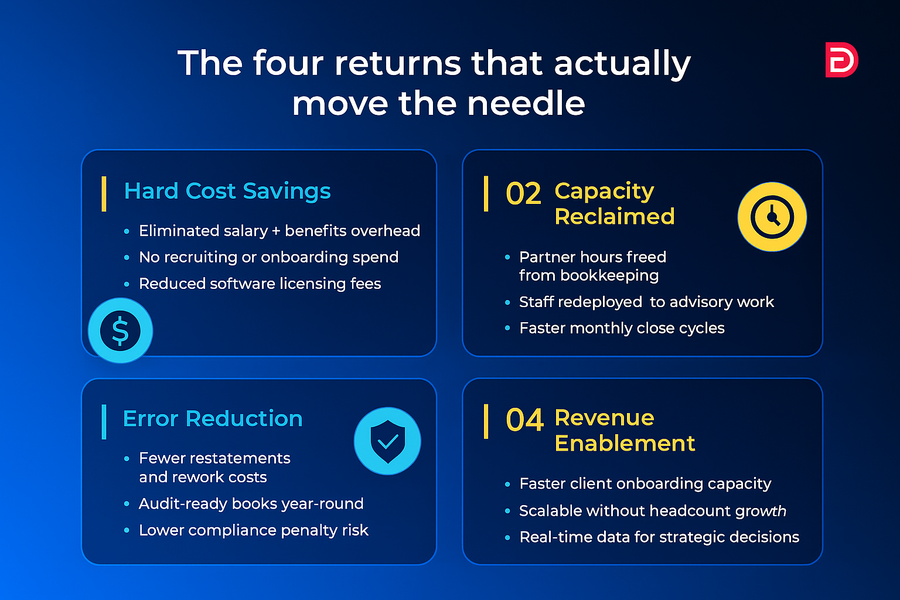

Infographic titled 'The four returns that actually move the needle' with four rounded panels: 01 Hard Cost Savings (bullets) and a dollar icon, 02 Capacity Reclaimed (clock icon) with bullets, 03 Error Reduction (shield icon) with bullets, 04 Revenue Enablement (bullets) with bullets.

Build the honest in-house baseline first

You can’t calculate return without a real baseline, and the real baseline is the fully loaded cost of a staff seat. Not salary. The whole thing.

That means benefits, payroll taxes, recruiting fees, onboarding, training, software licenses, workspace, and the off-season idle time when a compliance hire has less to do. Most firms undercount several of these, which flatters the comparison and inflates the apparent ROI of outsourced bookkeeping services before the work even starts.

The recruiting cost alone is heavier than it used to be. Hiring cycles have stretched as the credentialed pool shrinks. When hiring cycles stretch, existing staff absorb the work, close timelines slip, and error risk rises.

Here’s the discipline: build the baseline as if a skeptical partner will audit every line. The downside of an inflated baseline is worse than a conservative one. Overstate your in-house cost, and you’ll credit outsourcing with savings it never delivered, then wonder later why the numbers didn’t hold up.

Capacity reclaimed: the metric most firms never track

This is where compounding returns actually live, and almost nobody measures it. Shift a partner’s hours from $150 compliance work to $300 advisory work, and the return isn’t the labor you saved. It’s the higher-value revenue that time now produces.

Advisory is where the market is heading anyway. The market is no longer purely about compliance work: advisory services, AI integration, and real-time financial reporting are becoming the largest drivers of new revenue for accounting firms of every size. Reclaimed capacity is how you actually chase that shift instead of just talking about it.

But there’s a real catch, and it’s the one firms skip. Reclaimed time only counts if it converts to billable advisory. If those freed hours quietly get reabsorbed into admin, email, or firefighting, your capacity return is zero, no matter how much work you offloaded.

So track it directly. Measure advisory hours billed before and after go-live. Without that before-and-after, “reclaimed capacity” is just a story you tell in the pitch deck.

Learn How We Helped a Top CPA Firm Lower Their Tax Preparation Costs – Download the Case Study.

A simple ROI formula, and where it lies to you

The math looks clean: gain minus cost, divided by cost. Run it and you get a percentage you can put on a slide. Partners love it because it fits in one line.

Here’s the thing: that formula is honest about arithmetic and dishonest about timing. It assumes the outsourced team was fully productive from day one, that no work came back for rework, and that your own staff spent zero hours managing the relationship. None of that is true in month one.

A defensible outsourced accounting service ROI number accounts for the ramp. A team learning your chart of accounts, your review standards, and your client quirks won’t hit stride until the second or third cycle.

So run the formula twice. Once with the headline figure for the board. Once with transition friction, quality rework, and the ramp period subtracted out. The gap between those two numbers is the honest measure of what you signed up for.
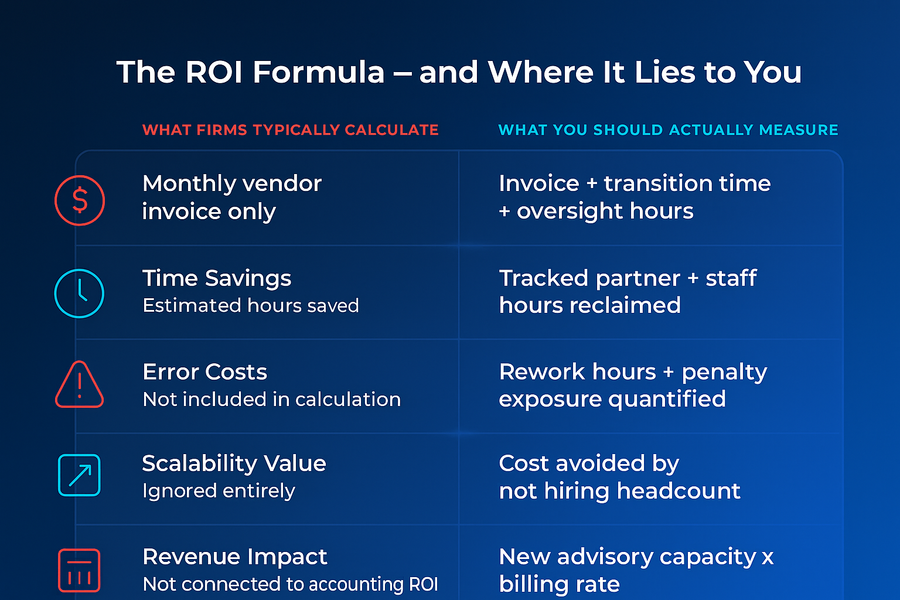
Infographic titled 'The ROI Formula – and Where It Lies to You' showing two columns: what firms calculate vs what you should measure, with icons and rows like monthly vendor invoice only vs invoice + transition time, time savings, error costs, scalability value, revenue impact.

The costs that quietly eat your return

Every engagement carries costs that never appear on the invoice. Pretend they’re zero and you’ll end up disappointed with a decision that was actually sound.

Four deductions matter most. Onboarding time, when your senior staff document processes they’ve never had to write down. Review overhead, because someone on your side still signs off on the work. Security due diligence, which is real labor if you’re vetting a partner properly. And communication drag: the emails, calls, and clarifications that come with any handoff.

None of these are dealbreakers. They’re just line items most firms forget to count.

The return on investment of outsourced accounting services still holds up when you subtract them, in most cases. The point isn’t to scare you off. It’s that a firm which budgets for these costs upfront gets a calmer first quarter and a more accurate scorecard than one that assumes the transition is free.

To be fair, these costs shrink fast after the first cycle.

How to measure tax-season ROI differently

Busy-season return doesn’t follow the same rules as the rest of the year. Judging surge capacity on an annualized rate misses the entire point of why you bought it.

During tax season, the return shows up in what you avoided. Overtime you didn’t pay. Burnout-driven turnover you didn’t absorb the following fall. Returns delivered on time instead of extended. Those are the numbers that matter from January through April.

This creates something firms rarely acknowledge: your busy-season ROI and your off-season ROI are genuinely different calculations. One is measured against capacity you couldn’t have staffed permanently. The other is measured against a full-time seat you’d otherwise carry year-round.

Given that the AICPA has documented a sustained decline in accounting graduates and CPA candidates in recent years (Source: AICPA Trends Report), the value of surge capacity you don’t have to recruit has climbed. The accounting outsourcing ROI on seasonal work is often higher than firms expect, precisely because the in-house alternative is so expensive to build and idle for eight months.
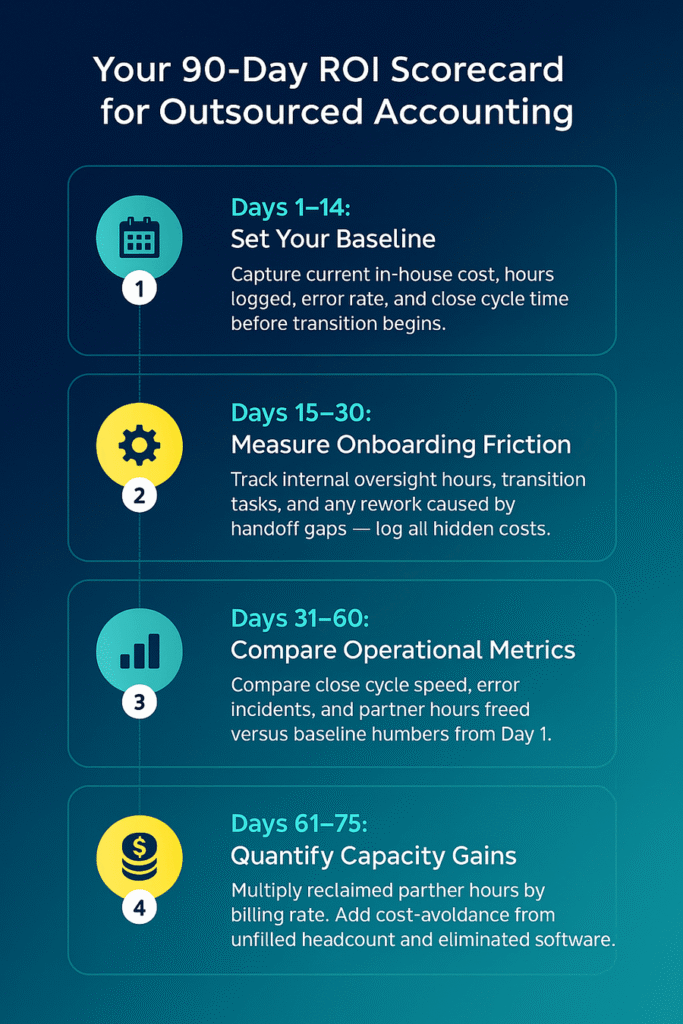

Infographic titled 'Your 90-Day ROI Scorecard for Outsourced Accounting' showing four steps with icons and descriptions for baseline, onboarding friction, operational metrics, and capacity gains.

Talk it through before you sign

Before committing to any provider, do the unglamorous work first. Map the fully loaded cost of one staff seat, and be honest about the advisory revenue currently trapped inside compliance work your partners shouldn’t be touching. That baseline is the foundation of every ROI figure you’ll ever calculate.

Then have a candid conversation about which of the four returns your firm is actually positioned to capture, because it’s rarely all four at once. If you’d like a second set of eyes on that baseline, the team at Datamatics Business Solutions works with CPA firms on exactly this question and is glad to talk it through, no slide deck required.

Start with total gains from the engagement, then subtract total costs, and divide by those costs. Gains include reclaimed partner hours, faster close cycles, reduced error correction, and revenue from capacity you freed up. Costs include the service fees plus onboarding and oversight time. Express the result as a percentage. The key is capturing outcome-based value, not just comparing the hourly rate to an in-house salary, which ignores the actual return the engagement produced.

If your C-corporation uses a fiscal year instead of a calendar year, your filing deadline is different. The original deadline is the 15th day of the fourth month after your fiscal year ends. If you file for an extension, you get six more months to file your tax return.

The hourly rate measures input, not outcome. A low rate tells you what you pay, not what you receive. Two providers charging the same rate can deliver very different results in accuracy, turnaround, and strategic insight. Focusing on rate alone hides the value of faster closes, fewer errors, and partner time returned to billable work. Judging the engagement by rate is like judging a car by its fuel price rather than where it takes you.

Track time-based, quality-based, and financial metrics. Time metrics include close cycle length and partner hours reclaimed. Quality metrics include error rates, rework frequency, and compliance issues avoided. Financial metrics include cost per transaction, revenue gained from freed capacity, and total cost of ownership versus in-house staffing. Also monitor client satisfaction and reporting turnaround. Combining these gives a fuller picture than any single number and connects the service directly to business outcomes.

Most firms see measurable returns within three to six months, once onboarding settles and workflows stabilize. Early weeks often show reduced value as both sides align on processes and expectations. By the second quarter, benefits like faster closes, fewer errors, and reclaimed partner time typically become visible. Full ROI, including gains from redeployed capacity, usually appears within the first year. Setting a baseline before you start makes these improvements easier to quantify.

Look beyond the invoice. Include onboarding and training time, internal oversight and review hours, software or integration expenses, and time spent managing the relationship. Also account for transition costs during the switch and any temporary dip in productivity while workflows adjust. Ignoring these overstates your return. A complete ROI calculation weighs total cost of ownership against total value delivered, giving you an accurate figure rather than a flattering one that only counts the service fee.

SHARE:

Related posts

Tags

Get in touch

I consent to processing of my personal data entered above for Datamatics Business Solutions to contact me and receive occasional marketing communications. For more information, please read our Privacy Policy and Terms of Use.
By providing your information, you agree to our Privacy Policy and Terms of Use.

Content Library

Resources

Let’s discuss how DatamaticsCPA can streamline your processes. Drop your details below!

By providing your information, you agree to our Privacy Policy and Terms of Use.
icon_right-1.png

Thank You!

Your inquiry has been received. Our expert will contact you shortly.