


Trust and estate tax returns are not like other filings. Form 1041 preparation involves DNI calculations, income and principal allocation, and K-1 distribution to beneficiaries. This work demands specialized fiduciary tax expertise most firms can’t justify staffing for year-round. That’s why so many CPA firms outsource trust and estate tax returns instead of stretching thin internal teams.
This article breaks down why firms make this move, what specialized trust and estate tax outsourcing actually solves, and how to evaluate a provider before you commit.
Key takeaways
- Trust and estate returns carry complexity that resists junior delegation. DNI and K-1 errors don’t stay contained to one return.
- Fiduciary tax specialists are hard to hire and harder to retain, making in-house staffing a fragile long-term plan.
- Not all tax outsourcing is equal. A generalist provider and a specialized fiduciary tax partner are different categories of decision.
- The right outsourcing partner reduces liability and protects referral relationships, not just workload.
Why trust and estate returns are different
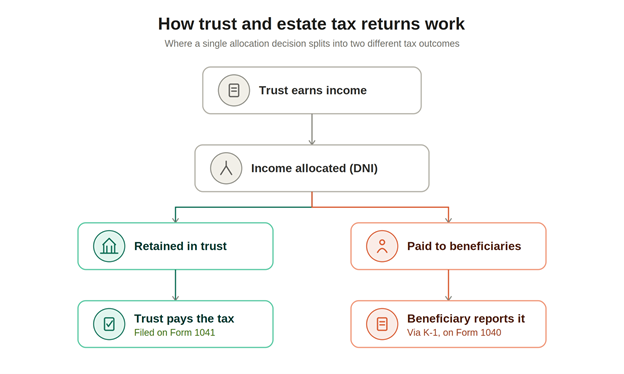
A 1040 reports one taxpayer’s income. A trust and estate return has to decide who owes the tax first. Income can stay with the trust or pass to beneficiaries, and that DNI allocation changes who pays and how much. Add situs rules, grantor trust status, and multi-beneficiary K-1s, and a single filing decision now affects several other people’s returns. That’s what makes this return type harder to standardize, and harder to hand off, than most other tax work.
| Why firms outsource | How outsourcing helps |
|---|---|
| 01DNI and K-1 work needs specialized judgment | Trained fiduciary experts, not just software. |
| 02Specialists are scarce and costly to hire | Access to expertise without a full-time salary. |
| 03Deadlines collide with tax season | Absorbs the seasonal overlap. |
| 04Errors reach every beneficiary’s return | Formal review catches errors early. |
| 05A bad return can end a referral relationship | Reliable accuracy protects the pipeline. |
| 06Complex trust work is often underpriced | Adds capacity without the realization hit. |
| 07Multi-state and situs rules are easy to miss | Regular exposure keeps expertise sharp. |
| 08One departure can wipe out capacity | Removes the single point of failure. |
| 09Trust files hold sensitive information | Security certifications protect it by design. |
Form 1041 work demands expertise most firms can't staff for
Form 1041 preparation requires skills that go beyond standard tax return experience. Preparers must calculate distributable net income accurately, decide how to allocate income between principal and interest, and distribute K-1 forms correctly to each beneficiary.
These tasks require judgment built through repeated exposure to fiduciary tax work, not just familiarity with tax software.
Firms that assign this work to junior staff or preparers used to individual returns often see mistakes that surface only after filing. This gap in staffable expertise pushes many firms toward Form 1041 outsourcing, where preparers handle trust returns as a dedicated specialty rather than an occasional task.
Fiduciary tax specialists are hard to hire and harder to retain
Firms that want to build in-house fiduciary tax capacity face a small hiring pool. Preparers with real experience in trust and estate returns are harder to find than general tax staff, and many of the most experienced ones are approaching retirement.
Training a new preparer to handle DNI calculations, grantor trust status, and K-1 allocation with confidence takes years, not months.
When a firm’s one specialist retires or leaves, replacing that knowledge on short notice is difficult. This scarcity is a major reason firms choose fiduciary tax return outsourcing instead of trying to build the same depth internally.

Trust deadlines collide with the rest of tax season
Extended Form 1041 submissions frequently coincide with the busiest segment of 1040 season. The same partners who examine the two tax forms are also competing for the same time slot. The firm that has few fiduciary tax workers has to choose between preparing tax returns on an individual basis and devoting resources to the completion of trust returns.
The timing conflict increases firms’ stress levels precisely when it is essential to be as accurate as possible because of the fact that K-1 allocations and DNI calculations do not allow any haste in processing.
Contracts with outside firms enable the companies to divide the workload on trust returns from the remaining tax season, so none of the segments gets less attention.
Errors here don't stay contained to one return
A single mistake in a Form 1041 return does not stay isolated. A miscalculated DNI figure or a misallocated K-1 flows directly into each beneficiary’s personal tax return. One error on a trust filing can create inaccurate filings for every beneficiary connected to it, multiplying the firm’s liability.
Correcting this after the fact means amending the trust return and every affected personal return it touched. This downstream risk differs from a standard 1040 error, which usually stays contained to one taxpayer.
Firms weigh this multiplied liability heavily when deciding whether trust and estate tax outsourcing can reduce their risk rather than add to it.
One wrong return can cost the referral relationship, not just the client
Estate attorneys and wealth managers refer clients to a CPA firm based largely on this one service line.
A late or inaccurate trust return reflects directly on the firm’s reputation with these referral sources, regardless of how strong the firm’s other services are.
Losing an estate attorney’s trust often means losing every future referral from that relationship, not just the current client. This makes trust and estate work higher stakes than its revenue share alone would suggest.
Firms that outsource to a specialized provider protect this referral pipeline by reducing the chance of errors or missed deadlines reaching the attorney or advisor who sent the client.
Complex trust work is chronically underpriced
Companies typically apply the same pricing system used for Form 1040 to Form 1041.
Although preparing an estate tax return is time-consuming due to the requirements of income distributions and allocations, firms do not seem to charge a higher fee for doing this work. As a result, a realization problem arises: trust work is not profitable for the firm.
Because this work is time-consuming without bringing in a corresponding amount of revenue, partners have less motivation to keep it in-house. Outsourcing estate tax returns allows an organization to use a provider who has specialized staff for this task.
Multi-state and situs rules add a layer most preparers don't see often enough to stay sharp
Trust organizations continue moving to states with lower taxes. This trend introduces new questions of jurisdiction that most tax professionals do not have to think about.
Knowing which states can tax the trust and whether the residency rules apply to the trustees and beneficiaries requires a level of expertise unavailable to institutions filling only a few trust returns in a year.
Tax advisers who encounter these issues merely from time to time lack the fluency that comes from an experience of multiple cases of interstate taxation.
One person leaving can wipe out a firm's fiduciary tax capacity
A lot of companies depend on one expert for understanding trust and estate tax. When that individual retires, quits, or takes a long leave, a particular firm does not have anyone else with such background that the first expert has.
This creates a continuity risk which other departments with many qualified preparers do not face. The expertise has to be rebuilt from nothing and the firm’s trust work gets exposed during that period.
Trust tax compliance outsourcing removes this situation by providing the company with a team that can perform the functions instead of one single individual.
Outsourcing adds capacity without adding fixed headcount
The volume of trusts and estate returns fluctuates throughout the year and makes it hard to rationalize the cost of hiring a full-time specialist. Certain periods will require substantial effort for fiduciary taxation while the others would need relatively little. This means that employment of a fiduciary expert has to account for both peak periods and off-peak times.
Using outsourced trust accounting solutions helps to match the needed demand depending on the season without incurring year-round expenses. The importance of this method is particularly pronounced in cases when audit load varies greatly from year to year.
💡 Is Outsourcing Right for Your Firm?
Take our quick self-evaluation to assess whether outsourcing or offshoring fits your firm’s goals.
Instantly discover how it can impact cost savings, capacity, and growth potential.
No commitment. Just tailored insights in less than 2 minutes.
The right partner brings formal review and data security controls firms can point to.
Fiduciary files contain delicate information about the finances and lives of beneficiaries and trustees alike. A qualified outsourcing company should have a well-thought-out review system for each return, not just a single preparer’s opinion. In this case, security certifications are as important as tax knowledge because a breach involving trust and estate data endangers vulnerable clients.
Companies that explore specialized tax outsourcing for CPA firms shall ensure the provider possesses records verifying both quality control measures and the existence of security safeguards. Controls such as these provide the firm something to show whenever an estate attorney or wealth manager inquires about the client’s information safety.
A checklist before you outsource trust and estate returns
The 10 reasons above point to one thing: the risk in trust and estate tax outsourcing isn’t outsourcing itself, it’s outsourcing to a provider that treats a 1041 like any other return.
Firms that outsource trust and estate tax returns successfully tend to vet for the same handful of things before signing on.
Whether you’re evaluating Form 1041 outsourcing, broader fiduciary tax return outsourcing, or specialized tax outsourcing for CPA firms generally, use this as a quick reference.
- Named, dedicated fiduciary tax team, not a rotation
- Written plan for overlapping 1040/1041 deadlines
- Clear DNI/K-1 review process, with a named reviewer
- A continuity plan if your point of contact leaves
- A defined escalation path for judgment calls (e.g. situs)
- Pricing that scales with return complexity, not flat-rate
- Data security certifications covering sensitive beneficiary information
- A track record specific to complex trust tax return support, not general tax prep
- Turnaround commitments built around extended fiduciary filing deadlines
The bottom line
Trust and estate returns aren’t hard to outsource because they’re complex. They’re hard to outsource to the wrong partner.
Datamatics Business Solutions runs dedicated trust and estate (1041) and estate and gift (706) tax preparation, backed by a formal quality review process and SOC 1/2 Type II, ISO, and GDPR certifications. Firms get continuity, security, and specialized expertise, without adding fixed headcount for seasonal work.
Why do accounting firms outsource trust and estate tax returns?
Form 1041 work requires specialized expertise in DNI calculations and K-1 allocation. Most firms can’t justify staffing for that expertise at low, seasonal volume. Outsourcing gives them access to it without a full-time hire.
What are the benefits of outsourcing Form 1041 preparation?
It reduces the risk of costly allocation errors. It frees up senior staff during overlapping deadline periods. It adds capacity that scales with seasonal volume instead of sitting idle the rest of the year.
What to look for in tax accounting outsourcing firms?
Look for a named, dedicated fiduciary tax team. Look for a documented review process. Look for data security certifications. Avoid a generalist tax prep shop that treats trust returns like any other filing.
Can an outsourced provider handle high-net-worth trust and estate returns?
Yes, but only if they have dedicated fiduciary tax expertise. HNW trust returns involve grantor trust status and multi-state complexity. A generalist preparer isn’t trained to handle that.
How do firms decide which trust and estate returns to outsource versus keep in-house?
Most firms route by complexity, not volume. Straightforward returns go to a broader team. Complex trust and estate filings go to a specialized team. Either way, the reviewing partner signs off.