


If you’re a Tax Director or Tax Manager, your Halloween starts in the first week of October itself. Not with costumes or candy. But, with overflowing work queues, looming deadlines, and the dreading “October 15 is only days away” realization.
Although the October 15 tax extension deadline offers some relief initially, it soon becomes a bottleneck for CPA firms. The incomplete returns are complex, require careful preparation, thorough reviews and being hand in glove with clients who may be providing information at the last minute.
Meanwhile, your team is already coming off months of peak-season pressure. Half the K-1s came in late. A few trust and estate returns are still waiting on documents. And your best preparer, the one everyone relies on, looks exhausted.
This is not a staffing problem you can fix by hiring in September. It is too late for that. And, the US is already undergoing a massive accounting talent shortage.
What most firms actually need in this final stretch is not more people. It is the right kind of help, for a short window, without the long onboarding. It is not about whether your firm can handle the work. The real ordeal is whether your team has enough headspace to file the returns without compromising accuracy.
Key takeaways:
- October 15 workloads are broader than C-corp returns. They include extended 1040s, trust and estate filings, and other business returns still stuck in review.
- The problem isn’t skill but your team’s capacity. Your team knows how to do the work, they just don’t have enough hours left to do it carefully.
- The usual fixes (temp hires, longer hours, pulling partners into prep) all break down once the deadline is two weeks out.
- Good tax outsourcing support slots into your existing workflow. It doesn’t ask you to rebuild your process during your busiest weeks.
- Datamatics Business Solutions fills the capacity gap while your team keeps the review, the client relationship, and final sign-off on every return.
- The payoff is: fewer burned-out staff, more partner time for advisory work, and a firm that can scale without adding fixed overhead.
Why the October 15 tax extension deadline creates a challenge for CPA firms
The October 15 tax extension deadline creates a different operational environment than the regular tax season.
April deadlines are often associated with high-volume individual filings. But, October workloads frequently involve returns that require additional attention and coordination. These may include:
- Individual returns waiting on late-arriving information
- Returns involving multiple income sources or complex schedules
- Business-owner returns requiring additional review
- C-Corporation returns with supporting schedules and documentation requirements
- Returns delayed due to missing information or extended client timelines
As the deadline approaches, every remaining return becomes more time-sensitive.
At the same time, internal teams are often balancing preparation, review, client communication, and administrative responsibilities. This creates pressure throughout the organization. Whether it is for preparers managing workloads or tax managers overseeing review queues.
💡 Is Outsourcing Right for Your Firm?
Take our quick self-evaluation to assess whether outsourcing or offshoring fits your firm’s goals.
Instantly discover how it can impact cost savings, capacity, and growth potential.
No commitment. Just tailored insights in less than 2 minutes.
What creates this impending pressure?
Deep down, the October 15 rush is a capacity issue. And, tax managers and firm leaders often face several competing priorities. These are:
- Experienced professionals get pulled into preparation work.
Senior tax professionals bring significant value to the table in various manners. However, during peak periods, these professionals may spend substantial time completing routine preparation tasks because additional capacity is unavailable.
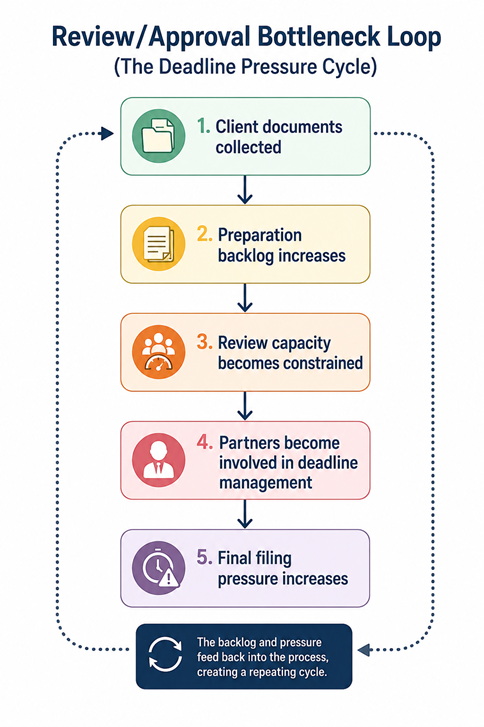
2. Review/approval queues become bottlenecks.
Even when preparation work is progressing, limited reviewer availability can slow completion.
3. Employee burnout becomes a business risk.
Repeated periods of extended hours can affect your employees in multiple ways:
- Employee satisfaction
- Retention
- Productivity
- Long-term team stability
Suggested read: 5 red flags your cpa firm is burning out before tax season
For many firms, the goal is not simply getting through October 15. It is doing so without exhausting the people responsible for future growth.
Why traditional solutions and fixes don’t work
October Crunch
Every October, firms lean on the same three moves.
Here’s why each one breaks down once the deadline is two weeks out.
| The Traditional Fix | Why It Fails This Close to the Deadline |
|---|---|
| Move 1 Hiring temporary staff | Good preparers are not sitting around waiting for a six-week contract in September. And if you do find someone, training them eats into the time you were trying to save. |
| Move 2 Working longer hours | Works for a week, maybe two. After that, mistakes start creeping in on returns your team would normally catch. The most burned out staff often quit right after the season, so you lose them for good, not just for October. |
| Move 3 Pulling partners into preparation work | Solves the immediate problem but creates a slower one. Every hour a partner spends on a 1040 is an hour they are not spending with a client who might bring in more business next year. |
What effective last-mile tax support should look like
Outsourcing during the October 15 period should not be viewed as replacing internal teams.
The most effective approach is to add capacity that works alongside the firm’s existing processes.
A reliable tax outsourcing partner should provide:
1. Alignment with existing workflows
Every CPA firm has its own approach to:
- Preparation procedures
- Documentation standards
- Review processes
- Client requirements
Effective support should integrate into those workflows rather than requiring firms to completely change how they operate.
2. Tax preparation expertise
Tax firms need confidence that additional resources understand the requirements involved in preparing:
- Individual tax returns
- C-Corporation returns
- Supporting schedules
- Related tax documentation
The purpose of additional support is to help firms increase capacity while maintaining the standards their clients expect.
3. Strong security and confidentiality practices
CPA firms manage highly sensitive client information. An extended tax deadline outsourcing partner must prioritize:
- Data protection
- Confidential handling of client information
- Controlled access
- Secure processes
Trust is the foundation of a successful overflow tax preparation support partnership.
4. Flexible capacity when demand increases
Tax workloads are naturally seasonal. Firms need the ability to scale resources during peak periods without creating unnecessary fixed overhead during slower months.

How Datamatics Business Solutions supports CPA firms during the October 15 push
During this season, most CPA firms are not looking for a complete change in their tax process. You already have established workflows, seasoned reviewers, and systems in place. The challenge is the volume of work that remains.
At Datamatics Business Solutions, we understand that a Tax Manager may have multiple extended returns still moving through different stages of completion. Some may be waiting for final client information. Others may require additional preparation, supporting schedules, reconciliation work, or review before they can be filed.
This is where additional preparation capacity makes a measurable difference.
We provide experienced tax professionals who work inside your existing preparation process.
Your team keeps the review, the client relationship, and the final say on every return. Datamatics Business Solutions fills the capacity gap underneath that, not around it.
In practice, that looks like:
- 1040 outsourcing services for individual returns still stuck in the queue
- 1120 corporate tax outsourcing for calendar-year C-corp filings on extension
- Support for trust, estate, and other extended business returns
- Workpaper preparation so your reviewers are not starting from a blank page
- Extended tax deadline outsourcing that scales down once October 15 passes
The point is not to hand off your tax work. It is to give your team enough room to get through the deadline without burning out or cutting corners.
An ‘outsourcing vendor’, A trusted ‘tax preparation partner’
The difference between a vendor and a trusted outsourcing partner comes down to understanding. Anyone can send you an evaluation portfolio and call it outsourcing. A real partner behaves differently from day one.
| A Vendor | A Partner |
|---|---|
| Hands you a resource and waits for instructions | Learns your workflow before the work starts |
| Cares about hours logged | Cares about whether the return is actually ready |
| Operates outside your process | Works inside it |
| Shows up for one deadline | Sticks around for the next one too |
You usually find out which one you hired around the third review cycle. By then, it is often too late to switch.
Still unsure whether to outsource your tax preparation services? Take this 2-min quiz and find out.
Building confidence in your October 15 tax preparation process
If you have never used outsource tax return preparation before, you are probably wondering about a few things.
- Will the quality hold up?
Your review process does not go away. Every return still passes through your team before it goes out the door. Support work simply gives your reviewers more finished drafts to work from, not fewer checks.
- Will this take too long to set up?
Last-minute tax filing help for CPA firms only works if it moves at the speed of the deadline. This is not a six-month implementation. It is built to plug in fast, because that is the whole point.
- Is my client data actually safe?
This should not require a leap of faith. Ask for specifics on access controls and data handling before you sign anything, and expect clear answers.
Not sure where to find the right outsourcing partner? Check out our curated list of the Top 7 Tax Preparation Outsourcing Companies for CPAs in USA.
Finalized a partner? Follow our phase-by-phase onboarding checklist to ensure a smooth collaboration with your preferred outsourcing partner.
What to do post Oct 15-deadline and why it matters
While the immediate goal may be completing remaining returns before the deadline, the benefits of additional capacity extend beyond tax season.
For tax teams:
- Better workload balance
- Reduced deadline pressure
- More time for complex work
For managers:
- Improved workflow control
- Greater operational flexibility
For partners:
- More time for advisory services and client relationships
For firms:
- Greater ability to scale without continuously increasing internal overhead
Suggested read: Filed your Oct 15 deadline? Don’t fall into the post-tax season trap.
Get through October 15 without burning out your best people
Getting through the October 15 tax extension deadline takes more than a few extra hands. It takes people who already know how to do the work, who fit into your process without slowing it down, and who show up again next year because the arrangement actually worked.
If your firm is buried in extension returns right now, it might be worth a conversation before the next deadline sneaks up on you.
Learn how Datamatics Business Solutions supports CPA firms with reliable 1040 and 1120 outsourcing services during peak filing periods, along with support for trust and estate filings.
What is the deadline for extended individual and C-corp tax returns?
The deadline for both extended individual and C-corp tax returns is October 15, 2026.
If your C-corporation uses a fiscal year instead of a calendar year, your filing deadline is different. The original deadline is the 15th day of the fourth month after your fiscal year ends. If you file for an extension, you get six more months to file your tax return.
How CPA firms can handle a surge in returns before October 15?
CPA firms can handle the surge in returns by
- auto-extracting tax data from client documents
- assigning returns to the next available preparer
- flagging missing forms before preparation
- auto-filling returns from prior-year data
- batch e-filing completed returns
Is it too late to outsource tax prep right before the October 15 deadline?
No, it is not too late to outsource tax prep right before the October 15 deadline. However, you should act quickly. Tax professionals and tax outsourcing partners handle extension-season work where availability can be limited. You can get in touch with the Datamatics team to check availability.
How fast can Datamatics Business Solutions start supporting my firm before October 15?
Most engagements can begin within days, not weeks. Since the model is built for peak-season timelines, onboarding is designed to move at the speed of the deadline, not a standard multi-week implementation.
Do Datamatics Business Solutions preparers work inside our existing tax software?
Yes. Datamatics professionals work within the tax software and systems your firm already uses, so there is no need to export data, switch platforms, or change how your reviewers access completed work.